
TL;DR:
- AI is now a core part of HR strategies, improving recruiting, engagement, and compliance.
- Successful AI implementation relies on combining automation with human oversight and ethical practices.
- Most organizations see significant benefits when integrating AI into core HR processes responsibly.
43% of organizations now use AI in HR, up from just 26% a year ago. That jump is not a trend. It is a structural shift in how large enterprises manage their most valuable asset: people. HR leaders who still treat AI as a back-office efficiency tool are missing the bigger picture. AI is now central to recruiting strategy, employee engagement, compliance, and organizational design. This guide breaks down exactly how leading enterprises are using AI across the full HR lifecycle, what risks to watch for, and why the human element remains irreplaceable.
Table of Contents
- Understanding the new HR-AI landscape
- How AI automates core HR processes
- Ensuring fairness, compliance, and trust with AI in HR
- Driving engagement and organizational transformation with AI
- Why AI can't replace the human touch in HR
- How to bring efficient AI to your HR strategy
- Frequently asked questions
Key Takeaways
| Point | Details |
|---|---|
| AI boosts HR productivity | Modern AI models, when paired with human oversight, deliver up to 29% productivity gains for HR teams. |
| Automation targets core functions | AI is revolutionizing recruitment, onboarding, and self-service—freeing HR for more strategic engagement. |
| Fairness and compliance matter | Human oversight, transparency, and regulatory alignment are crucial to avoid AI-related risks in HR. |
| AI empowers engagement | AI-driven tools are helping HR build personalized career paths and real-time engagement insights. |
Understanding the new HR-AI landscape
For decades, HR was seen as the department that processed paperwork and handled disputes. AI is changing that reputation fast. Today, HR teams that adopt AI well are becoming genuine strategic partners to the business, not just administrators. The shift is real, and it is measurable.
The key transformation frameworks driving this change include four major methodologies that leading enterprises are adopting. First, the two-speed agenda: running operational HR processes at full automation speed while keeping strategic decisions at a deliberate, human-led pace. Second, agile multidisciplinary teams that blend HR professionals, data scientists, and business leaders to build and govern AI tools together. Third, human-in-the-loop governance, which ensures that AI recommendations are always reviewed by a qualified person before they affect employees. Fourth, hybrid operating model redesign, where AI handles volume and humans handle judgment.
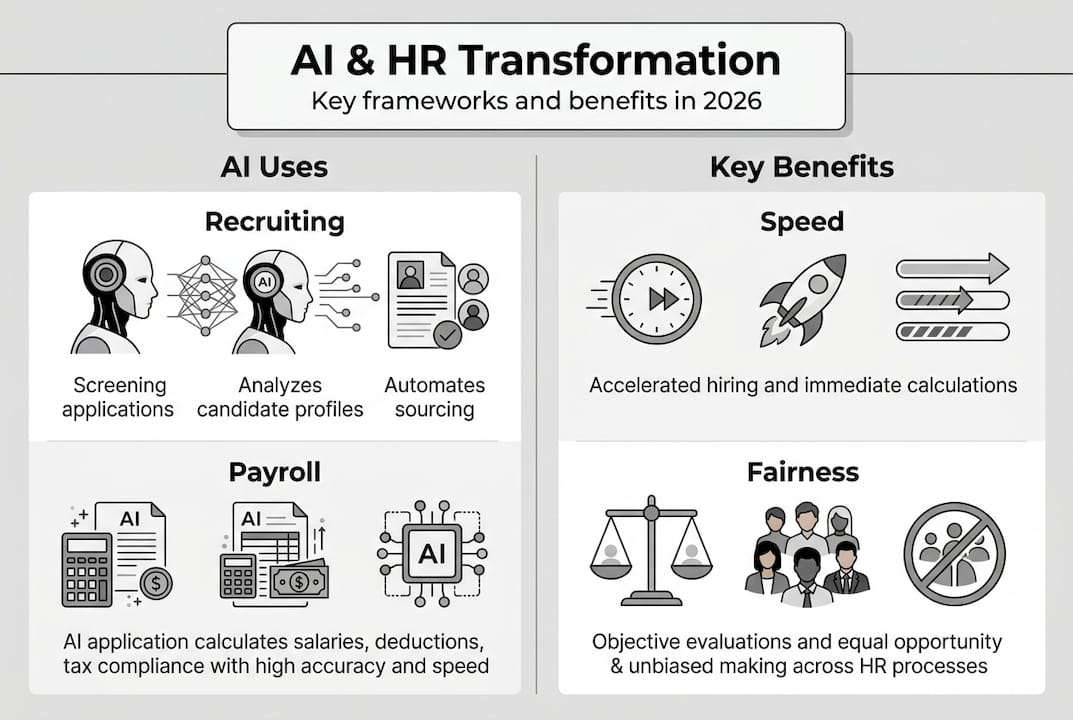
These are not abstract concepts. Gartner projects 29% productivity gains from HR operating models that combine AI and human expertise effectively. That is nearly a third more output from the same team, which is the kind of number that gets a CFO's attention.
Here is what the new HR-AI landscape looks like in practice:
- Talent acquisition: AI screens thousands of resumes in minutes, schedules interviews automatically, and flags potential bias in job descriptions before they go live.
- Employee development: Personalized learning paths are generated based on individual performance data and career goals.
- Workforce planning: Predictive analytics forecast attrition risk months in advance, giving HR time to act.
- Compliance monitoring: AI flags payroll anomalies and regulatory gaps in real time.
- Engagement measurement: Continuous sentiment analysis replaces the annual survey.
As Gartner's HR methodology research makes clear, the organizations seeing the biggest gains are not the ones with the most AI tools. They are the ones with the most disciplined approach to combining automation with human expertise.
"The future of HR is not human or machine. It is human and machine, each doing what they do best."
The enterprises pulling ahead are treating AI as a capability multiplier, not a headcount reducer. That mindset difference shapes every decision that follows.
How AI automates core HR processes
Knowing where AI fits strategically is one thing. Seeing how it performs on the ground is another. Let us walk through the four core HR functions where AI is delivering the most measurable impact right now.
| HR function | AI application | Key benefit |
|---|---|---|
| Recruiting | Resume screening, interview scheduling | Speed and consistency |
| Onboarding | Chatbots, document automation | Faster time-to-productivity |
| Payroll and compliance | Anomaly detection, error flagging | Accuracy and risk reduction |
| Employee self-service | AI portals, Q&A bots | Reduced HR ticket volume |
92% of organizations report major recruiting benefits from AI, and self-service AI has reduced HR inquiry volume by one-third on average. Those are not pilot program numbers. Those are enterprise-scale results.
Here is how the top-performing organizations are structuring their AI rollout across these four areas:
- Recruiting automation first. AI-powered screening tools evaluate candidates against structured, transparent criteria. This removes subjective first-impression bias and dramatically shortens time-to-hire.
- Chatbot-led onboarding. New hires get answers to common questions instantly, complete paperwork through guided digital flows, and receive personalized day-one schedules, all without burdening HR staff.
- Payroll anomaly detection. AI monitors payroll data continuously, catching errors and compliance gaps before they become legal problems.
- Self-service portals at scale. Employees handle benefits queries, time-off requests, and policy questions through AI-powered portals.
The real-world benchmarks are striking. Deloitte deployed an AI-powered HR portal used by 19,000 employees, generating 1.5 million portal views and managing 53,000 HR cases. Honda achieved 29% portal adoption within just two months of launch. These results are not outliers. They reflect what happens when AI automation in business is deployed with clear goals and proper change management.

Pro Tip: Before deploying any HR AI tool, audit your existing data quality first. AI is only as accurate as the data it learns from. Garbage in, garbage out applies especially hard in HR, where decisions affect people's careers.
The right AI HR solutions integrate with your existing systems, including Workday, SAP, and ServiceNow, so you are not building a parallel infrastructure. You are making your current stack smarter.
Ensuring fairness, compliance, and trust with AI in HR
The efficiency gains from AI in HR are real. So are the risks. HR leaders who ignore the ethical and regulatory dimensions of AI are setting themselves up for serious problems.
Here is a direct comparison of where AI performs well versus where it creates risk:
| Area | AI strength | AI risk |
|---|---|---|
| Resume screening | Speed and consistency | Algorithmic bias |
| Performance evaluation | Data-driven objectivity | Opaque decision-making |
| Compliance monitoring | Real-time flagging | False positives |
| Employee sentiment analysis | Continuous insight | Privacy concerns |
Gartner flags recruitment as a high-risk zone for AI, citing compliance exposure, potential mental fitness impacts on employees, and the fact that only 45% of managers feel AI is meeting expectations in this area. That last number should give every HR leader pause.
The risks fall into several categories that require active management:
- Algorithmic bias: AI trained on historical hiring data can perpetuate past discrimination. Transparent criteria and regular audits are non-negotiable.
- Regulatory exposure: The EU AI Act classifies recruitment AI as high-risk, requiring documentation, human oversight, and employee notification. Similar frameworks are emerging globally.
- Workslop risk: This is the term for low-quality AI output that looks polished but is factually wrong or contextually inappropriate. In HR communications, this can seriously damage trust.
- Employee wellbeing: Constant AI monitoring can create anxiety if not implemented transparently and with clear employee communication.
The integration of AI in HR done right means building in human override at every decision point that affects an individual employee. AI can recommend. Humans must decide.
"AI in HR should always have a human signature on the final decision. Not because AI is untrustworthy, but because accountability requires a person."
The organizations navigating this best are the ones treating fairness and compliance as design requirements, not afterthoughts. They build bias audits into their AI procurement process and train HR staff to recognize when AI output needs human correction.
Driving engagement and organizational transformation with AI
Efficiency and risk management are table stakes. The real competitive advantage from AI in HR comes from what it enables at the human level: deeper engagement, faster development, and more adaptive organizations.
46% of managers are actively experimenting with AI tools, compared to only 26% of frontline employees. That gap matters. It means the people responsible for team performance are moving faster than the people on the ground, which creates a change management challenge that HR must lead.
Here is where AI is creating the most meaningful engagement impact:
- Personalized learning paths: AI analyzes skill gaps and career goals to recommend development content at exactly the right moment, not during the annual review cycle.
- Real-time engagement analytics: Instead of waiting for the annual engagement survey, AI processes continuous signals from communication patterns, productivity data, and pulse surveys to flag disengagement early.
- Career development conversations: AI tools help managers prepare for meaningful one-on-ones by surfacing relevant data about each employee's progress and aspirations.
- Adaptive change management: AI models help HR leaders predict how organizational changes will land with different employee segments, enabling more targeted communication strategies.
Stat to know: Organizations using AI for engagement analytics report spotting attrition risk an average of 90 days earlier than those relying on traditional surveys alone.
Pro Tip: Do not use AI engagement tools as a surveillance mechanism. Employees who feel monitored disengage faster. Frame AI analytics as a tool for giving managers better information to support their teams, and communicate that framing clearly.
The AI adoption benchmarks show that the enterprises seeing the biggest engagement gains are the ones where HR leaders champion AI as a tool for humanizing work, not replacing it. When AI handles the administrative load, HR professionals get time back for the conversations and decisions that actually move people.
Why AI can't replace the human touch in HR
Here is the perspective that gets lost in most AI-in-HR conversations: technology is the smallest part of the transformation. BCG's research articulates this clearly with what they call the 10/20/70 rule: 10% of value comes from the AI algorithm itself, 20% from the data and technical infrastructure, and 70% from people, culture, and process change. Seventy percent.
That means every enterprise that is investing heavily in AI tools while underinvesting in change management, training, and cultural alignment is leaving most of the value on the table. We see this pattern repeatedly. Organizations buy sophisticated AI platforms, deploy them without adequate HR leadership involvement, and then wonder why adoption stalls.
The AI automation guide we recommend to every HR leader starts with the same question: what human behaviors do you need to change for this technology to work? That question is harder than any technical implementation challenge. It requires HR leaders to do what they do best: understand people, build trust, and lead through uncertainty. AI can surface the data. Only humans can build the culture that makes acting on that data possible.
How to bring efficient AI to your HR strategy
If the concepts in this article resonate, the next step is finding an AI platform that fits the complexity of enterprise HR without requiring a team of developers to operate it.
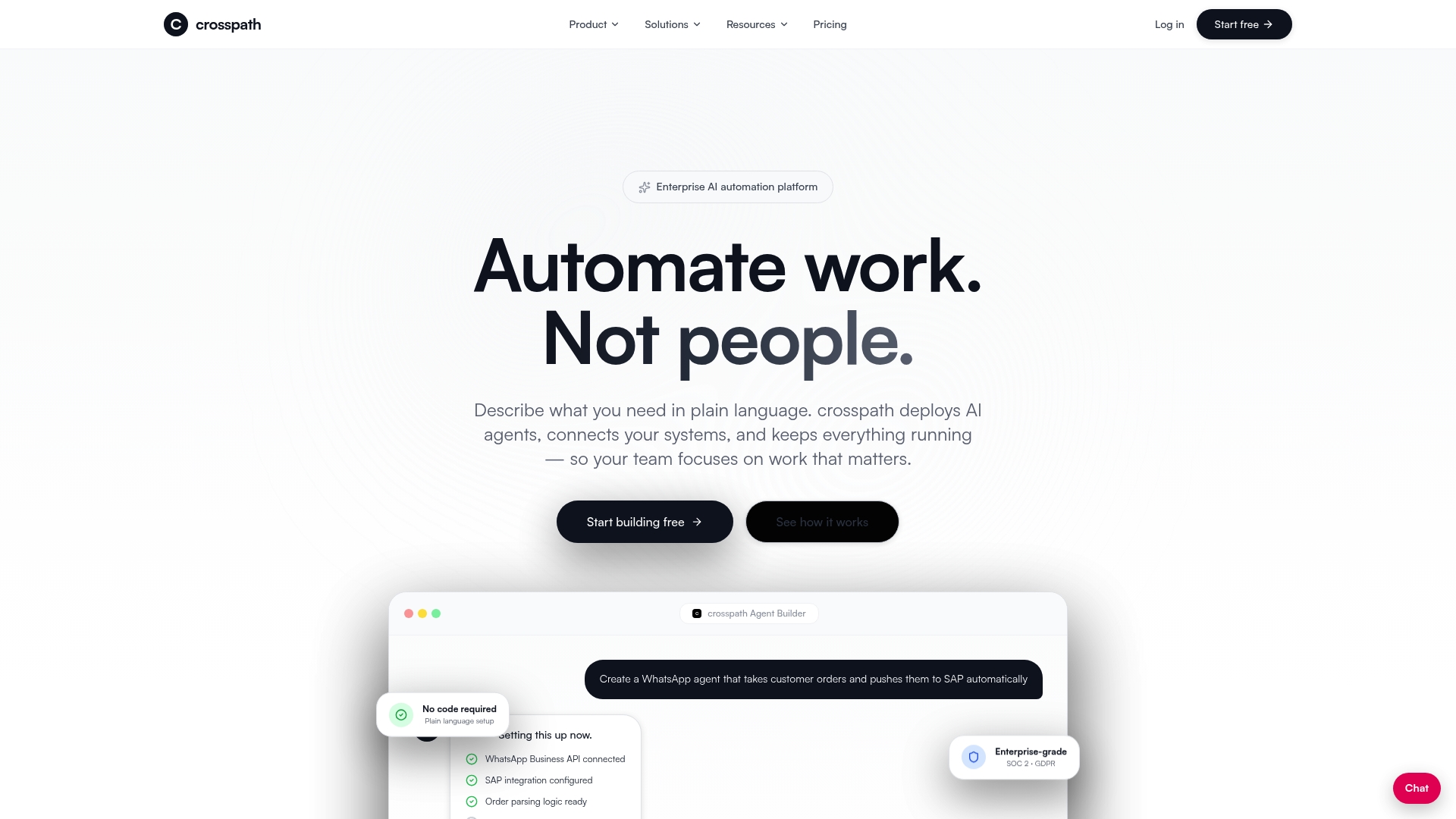
Crosspath is built for exactly this challenge. As an AI automation platform designed for large organizations, Crosspath lets HR teams build and deploy AI agents using plain language descriptions, no coding required. It integrates with over 500 enterprise tools including Workday, SAP, and ServiceNow, and supports deployment across Slack, WhatsApp, and web chat. With SOC 2 and GDPR compliance built in, it meets the security standards your organization requires. Explore the full range of HR automation solutions or visit Crosspath to see how your HR team can start automating responsibly today.
Frequently asked questions
What are the most common HR processes automated by AI today?
Recruitment, onboarding, payroll, and employee self-service are the most widely automated HR functions, with 92% of organizations reporting significant recruiting benefits from AI adoption.
How can HR leaders avoid bias in AI-powered recruiting?
Using transparent evaluation criteria, running continuous bias audits, and maintaining human override at every hiring decision point are the most effective safeguards against AI-driven discrimination.
What percentage of organizations currently use AI in HR?
43% of organizations now use AI in HR, a significant jump from 26% just one year prior, reflecting rapid enterprise adoption across all major HR functions.
What are the main risks of using AI in HR management?
The key risks include biased algorithms in recruitment, regulatory compliance gaps under frameworks like the EU AI Act, low-quality AI outputs, and employee wellbeing impacts from poorly communicated monitoring practices.