
TL;DR:
- Clear automation objectives and SMART criteria are essential to successful scaling.
- Strong governance, compliance, and AI TRiSM controls prevent risks and ensure accountability.
- Most failures stem from misaligned incentives, lack of staff buy-in, and unclear process goals.
Scaling IT automation across a large enterprise sounds like a clear win. Faster processes, fewer errors, and real cost savings are all on the table. But the path from pilot to production is where most programs stumble, running into compliance gaps, misaligned goals, and technology choices that don't hold up at scale. The good news is that these failures follow predictable patterns, which means they're preventable. This guide walks you through the specific best practices that automation leaders and IT decision-makers need to build reliable, compliant, and genuinely high-performing automation programs in 2026.
Table of Contents
- Define automation objectives and success criteria
- Establish strong governance, compliance, and AI TRiSM controls
- Prioritize AI-ready foundations and incremental adoption
- Transform processes with agentic AI and robust change management
- The uncomfortable truth about IT automation most leaders ignore
- Unlock scalable AI automation with CrossPath
- Frequently asked questions
Key Takeaways
| Point | Details |
|---|---|
| Start with goals | Clear objectives and success metrics are essential before launching IT automation. |
| Embed governance | Integrate compliance and AI TRiSM into every automation from the start for trust and scale. |
| Adopt incrementally | Begin with deterministic automation, build robust foundations, and scale towards agentic AI. |
| Prioritize change management | Lasting automation success depends on stakeholder buy-in, iterative adjustments, and continuous measurement. |
Define automation objectives and success criteria
With the stakes set, the very first step is to get clear about what you want automation to achieve. This sounds obvious, but it's where most programs quietly fall apart. Common pitfalls include vague success criteria and automating the wrong processes entirely, which wastes budget and erodes organizational trust before you've even scaled.
The fix starts with translating business goals into precise automation targets. "We want faster onboarding" is a business goal. "Reduce new-hire IT provisioning time from 4 days to 4 hours within Q3" is an automation target. That specificity is what makes planning, measurement, and accountability possible.
Apply SMART criteria to every automation initiative:
- Specific: Name the exact process, system, and outcome
- Measurable: Attach a number, percentage, or time unit
- Achievable: Validate feasibility with process owners before committing
- Relevant: Tie the target to a business priority leadership already cares about
- Time-bound: Set a deadline that creates urgency without being unrealistic
Key metrics to track from day one include ROI per process, cycle time reduction, compliance rate improvements, and error frequency before and after automation. These aren't just reporting numbers. They're your early warning system for when a deployed automation starts drifting.
Stakeholder involvement is non-negotiable. IT, operations, compliance, and the teams actually doing the work all need a seat at the table before you build anything. Their input surfaces edge cases, exception flows, and political landmines that no requirements document will catch on its own.
"Automating the wrong things early and vague success criteria are leading pitfalls" in enterprise automation programs. Getting this right upfront is what separates projects that scale from those that stall.
Pro Tip: Before committing to full automation, develop and test a hypothesis. Define what success looks like, run a small manual simulation of the automated process, and validate your assumptions. This saves months of rework on automation solutions that looked good on paper but failed in practice.
Establish strong governance, compliance, and AI TRiSM controls
After setting clear goals, lock in governance as your long-term insurance policy. Without it, automation programs scale their problems just as fast as they scale their benefits.

The biggest risk factors in enterprise automation are shadow IT, unmonitored bots running without oversight, and compliance gaps that only surface during an audit. These aren't hypothetical. They're the predictable result of deploying automation faster than your governance framework can keep up.
AI TRiSM, which stands for Trust, Risk, and Security Management, is the framework Gartner and leading analysts recommend for managing these risks at scale. It covers three pillars: establishing policies for how AI agents are allowed to act, building transparency so you know what every automation is doing and why, and implementing continuous monitoring to catch anomalies before they become incidents. Runtime enforcement is critical for AI security and trust, meaning governance can't just live in a policy document. It has to be embedded in the platform itself.
A practical automation governance checklist for enterprise teams should cover:
- Data access controls: Who and what can read, write, or move sensitive data
- Auditability: Every automation action logged with timestamps and user attribution
- Exception handling: Defined escalation paths when an automation encounters an unexpected state
- Role-based permissions: Separation of duties between builders, approvers, and operators
- Compliance mapping: Each automated process mapped to the relevant regulatory requirement (GDPR, SOC 2, etc.)
Stakeholder roles matter here too. IT owns the technical controls. Compliance officers own the regulatory mapping. Process owners own the exception logic. When these roles blur, accountability disappears and governance becomes theater.
Prioritize AI-ready foundations and incremental adoption
Good governance is only as effective as the foundations supporting it. Here's how to make your automation truly AI-ready.
Start with a process mapping exercise and a legacy system audit. You need to know which processes are well-documented, which systems have reliable APIs, and where the data quality issues live before you automate anything. Trying to automate a broken process just produces broken results faster.
The proven adoption sequence looks like this:
- Requirements gathering: Document the current process in detail, including exceptions and edge cases
- Proof of concept: Build a minimal version of the automation in a sandboxed environment
- Pilot launch: Deploy to a small, controlled user group and measure against your SMART targets
- User training: Equip the people who will work alongside the automation before go-live
- Iterative scaling: Expand based on pilot results, not on schedule
This sequence reflects lessons from enterprise RPA programs: assess requirements, obtain buy-in, evaluate vendors, train comprehensively, and adopt incrementally. Skipping steps to move faster is the single most common cause of automation rollbacks.
Here's a number worth sitting with: fewer than 15% of enterprises will have enabled true agentic AI by 2026, largely due to ROI uncertainty and governance immaturity. That means the majority of organizations should focus on deterministic automation first, which means high-volume, rule-based tasks with predictable inputs and outputs, and evolve toward cognitive use cases as their AI automation readiness matures.
Pro Tip: Document every system interface and process handoff point before you scale. The integrations between systems are where automation breaks under load. Detailed interface documentation is the difference between a clean scale-up and a weekend incident.
Transform processes with agentic AI and robust change management
Once the technical foundations are laid, focus turns to the people and processes powering automation.
Agentic AI refers to AI systems that can plan, decide, and act across multi-step workflows with minimal human intervention. Unlike traditional rule-based bots, agentic AI can handle variability, interpret context, and adapt its approach mid-process. The promise for IT automation is significant: faster incident resolution, dynamic resource allocation, and intelligent process routing that no static workflow could achieve.
But technology is only half the equation. Change management is key for automation success: address fears, close skill gaps, prove ROI, and take an iterative approach. Without this, even technically excellent deployments fail because the people who need to use and trust them don't.
Common resistance points and how to address them:
- Fear of job displacement: Show clearly which tasks are being automated and how staff roles will evolve
- Skill gaps: Invest in training before deployment, not after problems emerge
- Distrust of AI decisions: Build explainability into agentic workflows so staff can see why the AI acted as it did
- Process ownership conflicts: Clarify accountability for automated processes before go-live
| Agentic AI use case | Deployment hurdle | Solution |
|---|---|---|
| IT helpdesk triage | Staff distrust of AI routing | Explainability dashboards and override controls |
| HR onboarding automation | Cross-system data inconsistency | Data quality audit before automation build |
| Compliance monitoring | Regulatory uncertainty | Legal review integrated into governance checklist |
| Order processing | Exception volume too high | Start with highest-confidence cases only |
Leading organizations treat process transformation with agentic AI as a living discipline, not a one-time project. Governance, measurement, and human feedback loops are built into the operating model permanently.
Pro Tip: Pair every agentic deployment with dedicated ROI tracking from day one. Without baseline metrics captured before go-live, you'll spend months arguing about whether the automation actually worked. Learn more about agentic AI in enterprise contexts and how to structure your automation change management approach.
The uncomfortable truth about IT automation most leaders ignore
All these practices are essential. But what really separates the programs that scale from the ones that stall?
It's rarely the technology. The platforms available today, including tools that connect to over 500 enterprise systems without a line of code, are genuinely capable. The limiting factor is almost always misaligned incentives and ignored staff buy-in. Leaders approve automation budgets but don't restructure the incentives that reward manual workarounds. Managers nod along in steering committees but quietly undermine adoption because their team's headcount is tied to the process being automated.
Most automation projects don't fail dramatically. They die slowly in pilot purgatory, running in a test environment for 18 months while stakeholders debate edge cases that a clear objective would have resolved in week two. The rush to tools before clarifying the process problem is the real culprit.
The ROI of automation isn't just the headcount you remove. It's the agility you gain when your IT team stops firefighting and starts building. It's the trust you build with regulators when your compliance evidence is generated automatically and auditably. Long-term wins come from treating automation as a measured, iterative, human-centered discipline. That's what why CrossPath matters to enterprises that have moved past the pilot phase and need something that actually holds up.
Unlock scalable AI automation with CrossPath
Ready to put these best practices to work?
CrossPath is built specifically for enterprises that need to move fast without cutting corners on security or compliance. The platform lets your teams describe automation tasks in plain language, and CrossPath handles the configuration, integrations, and deployment across your existing systems.
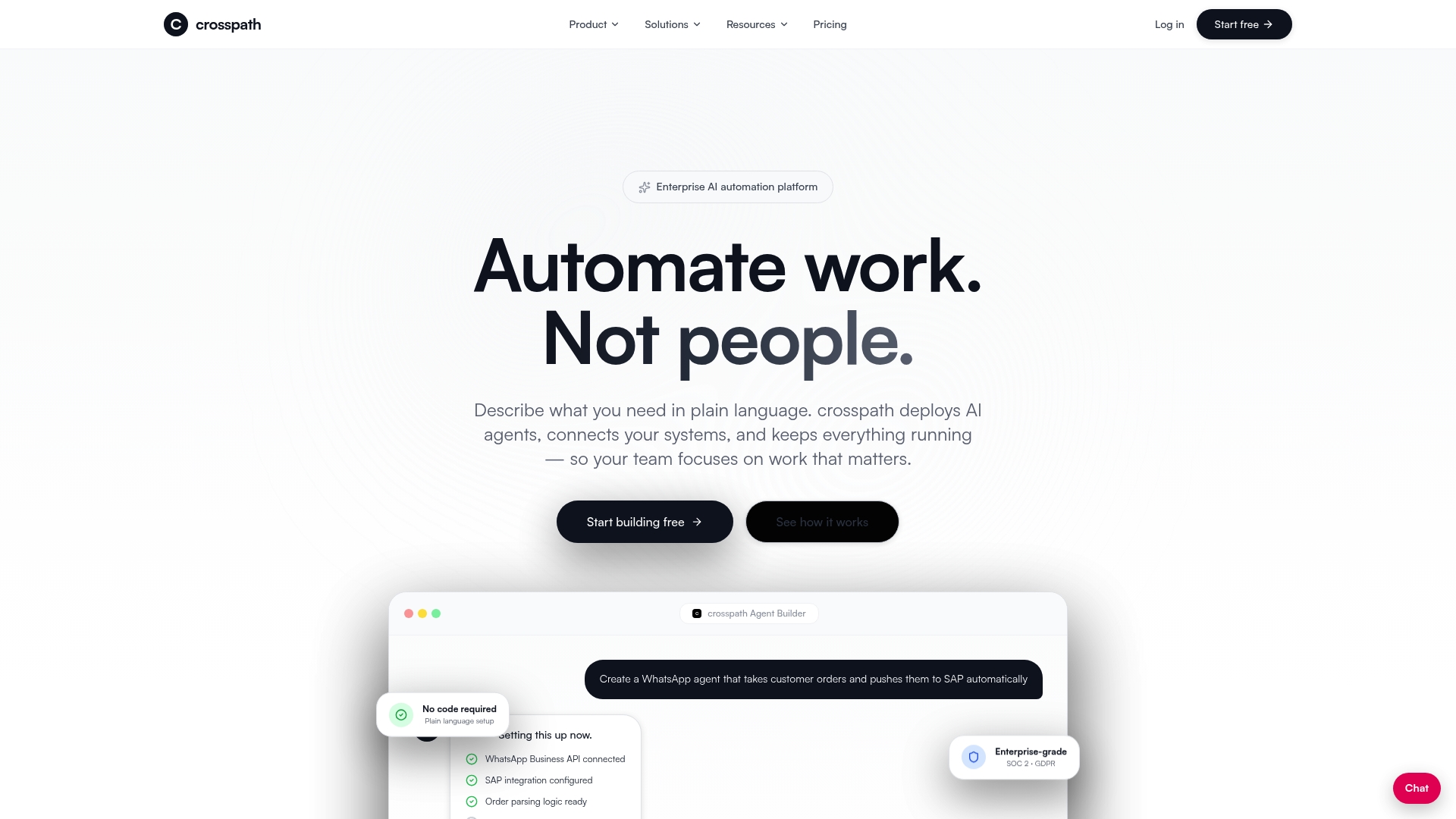
From SOC 2 and GDPR compliance to role-based access and on-premise deployment, every governance requirement covered in this guide is supported out of the box. Whether you're starting with deterministic workflows or scaling toward agentic AI, explore the AI automation guide and automation solutions to see how CrossPath fits your enterprise roadmap.
Frequently asked questions
What is AI TRiSM in IT automation?
AI TRiSM stands for Trust, Risk, and Security Management, covering the policies and controls that ensure AI-powered automations are secure, transparent, and compliant. Runtime enforcement is a core requirement, meaning these controls must be active during execution, not just at design time.
How do I measure automation ROI in large enterprises?
Focus on time saved, error reductions, compliance improvements, and cost reductions, using before-and-after metrics tied directly to your original business objectives. Cycle times, compliance rates, and error reduction are the most reliable leading indicators of automation value.
Can agentic AI replace all human IT processes?
No. Agentic AI can handle configured, multi-step tasks with high reliability, but fewer than 15% of enterprises have the governance maturity to deploy it broadly. Most organizations use it to augment human work, not replace entire roles.
What causes most IT automation projects to fail?
The top causes are unclear objectives, skipping change management, automating the wrong processes, and weak governance. Vague success criteria and automating the wrong things early are the most consistent failure patterns across enterprise programs.